
If you have noticed your body does not bounce back the way it used to, you are far from alone. A recent thread on Reddit’s r/Aging, called “Body Falling Apart From 50”, gathered dozens of people describing that same feeling: aches that linger, injuries that used to heal in weeks now taking months, or old injuries that never quite go away.
That feeling is real, and it is not the whole story. The body’s natural healing mechanisms are still there, at any age. They do not disappear at 50, 60, or 70. What often changes is how easily your body can access them on its own, and that is where the right doctor makes the difference.
If you have been told your only options are surgery, months of physical therapy, or opioids for pain management, it is normal to feel frustrated, even hopeless. Those paths can feel disconnected from what your body actually needs, especially when deep down it feels like healing should happen more naturally than that. The capacity to heal is already inside you. It always has been. What you may need is help accessing it.
The Body’s Repair Crew
When a joint or tendon is damaged, the body responds almost instantly. Blood, platelets, and repair cells flood the area, and those cells get to work laying down new collagen. Within a few weeks, most injuries in a younger body are simply resolved, often without the person giving it much thought.
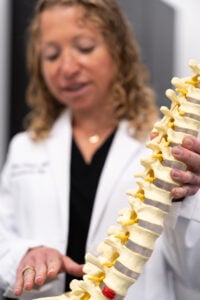
Alexandra DeFrance, PA-C, a board-certified physician assistant specializing in orthopedics and regenerative medicine at Pain Doctors Medical, describes these natural healing mechanisms as a supply and demand system.
“When you sprain an ankle or strain a tendon, your body floods the area with blood, platelets, and repair cells,” DeFrance says. “Those cells lay down new collagen, and over a few weeks, you are back. What changes after 50, and especially through menopause, is the supply. There are fewer repair cells, they respond more slowly, and the drop in estrogen makes tendon and ligament tissue less resilient. The instructions are still there. The workforce just got smaller.”
Why an Injury Sometimes Refuses to Heal
Most people assume an injury that will not heal is simply a bigger injury. Often, it is something else entirely. DeFrance points to three patterns she sees most often in patients across Brooklyn, Clifton, Newark, and Perth Amboy whose natural healing mechanisms seem to have stalled on an old strain or sprain.
“Usually one of three things,” DeFrance explains. “The joint keeps getting loaded the wrong way because nobody corrected the mechanics, so the tissue never gets a quiet stretch to heal. Or the blood supply in that spot is poor, which is true for a lot of meniscus and rotator cuff tears. Or the damage is simply bigger than what the body can bridge on its own. I also see people who rested for six months and lost the muscle that was protecting the joint, so now it is under more load, not less.”
As frustrating, or even hopeless, as this can feel, especially the older you get, there are real solutions. An injury that has stalled for months or years is not proof that your body has stopped healing. More often, it is a sign that something specific is blocking the process, and that something can usually be identified and addressed. This is where finding the right doctor changes everything. A physician who takes the time to understand your natural healing mechanisms, rather than treating only the symptom in front of them, can get to the actual root of the problem and help your body do what it already knows how to do.
How Regenerative Medicine Supports Your Body’s Own Process
At Pain Doctors Medical, treatment starts with the whole picture, including everything connected to the joint that hurts. “An injection is a product. What we do is a plan,” DeFrance says. “I look at the whole chain, because a knee is very often paying for a hip.” That plan follows the Regenexx protocol at every Pain Doctors Medical location, so the concentration returning to a patient’s body is processed to a known, tracked standard rather than whatever a bedside kit happens to produce. Every PRP or bone marrow placement is guided by ultrasound or fluoroscopic imaging, so the cells land directly in the injury rather than somewhere nearby. DeFrance also follows her patients well after the appointment itself. As she puts it, “Healing is a process, not an appointment.”
A Rotator Cuff That Healed On Its Own Terms
One story has stayed with DeFrance, maybe because so many patients see themselves in it. A woman in her early 60s came in already resigned to surgery. She had lived with shoulder pain for two years, quietly leaning on her neck and shoulder blade to do the work her rotator cuff used to handle, and a surgery date was already on the calendar. If any of that sounds familiar, the slow compensating, the appointments that come and go without real answers, you are not alone in that either.
“The tear on imaging was real but small,” DeFrance recalls. “What was keeping it open was how much she was compensating through her neck and shoulder blades.” Rather than send her straight into surgery, DeFrance treated the tear with the patient’s own bone marrow cells and corrected the mechanics feeding the problem. Months later, repeat imaging showed the tear had filled in. “Her body did that,” DeFrance says. “We just gave it a fair shot.”
For a patient who had spent two years bracing for an operation, that outcome was deeply personal. It was the difference between believing her body had failed her and realizing it had been trying to heal the whole time.
What This Means for You
Healing does not stop at any age. The body’s natural healing mechanisms are still working, even when an injury feels stuck. For people across Brooklyn, Clifton, Newark, and Perth Amboy who feel like their body has stopped cooperating, the right doctor can help you find and access those mechanisms again, rather than simply managing the pain around them.
Pain Doctors Medical, led by double board-certified physician Dr. Ilana Etelzon, MD, along with Alexandra DeFrance, PA-C, specializes in identifying exactly where healing has stalled and why, then building a regenerative medicine plan around restoring your body’s own natural healing mechanisms rather than masking the symptom on top of it.