

A BMAC procedure, short for bone marrow aspirate concentrate, uses concentrated cells drawn from your own bone marrow to support the repair of joints, tendons, and other soft tissue. It is an outpatient treatment, completed in a single office visit, using your body’s own biology rather than donor tissue or synthetic material. This guide covers what actually happens during a BMAC procedure, how it compares to other options, and what recovery looks like.
What Actually Happens on Treatment Day
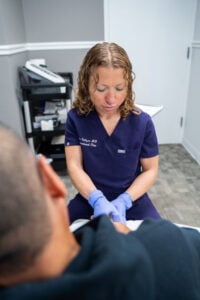
Alexandra DeFrance, PA-C, a physician assistant specializing in orthopedics and regenerative medicine at Pain Doctors Medical, walks every new patient through the BMAC procedure before it begins.
“We numb the back of the hip well, and I draw marrow from the pelvis through a small needle,” DeFrance explains. “Most people describe deep pressure for a few seconds rather than sharp pain.” The sample is processed and concentrated down to the specific cells needed for repair, and DeFrance then places it directly into the injured tissue using ultrasound or fluoroscopic guidance. According to Cleveland Clinic, the full BMAC procedure, from bone marrow aspiration through the final injection, typically takes about two hours from start to finish. Patients walk out the same day, and most report soreness at the hip site for a day or two afterward.
BMAC or PRP: How the Decision Gets Made
Pain Doctors Medical offers both PRP and a BMAC procedure, and DeFrance evaluates each patient individually rather than defaulting to one option. Her explanation is straightforward. PRP sends signals to the body’s existing repair cells. Bone marrow concentrate sends signals and the cells themselves.
If the tissue still has enough of its own repair capacity, a mild tendon issue or early cartilage wear, platelets alone are often enough to get the job done. DeFrance turns to a BMAC procedure when there is genuine structural loss involved: thin cartilage, a larger tear, a ligament that has been loose for years, or a patient who already tried platelets elsewhere and only got partway to relief. Age plays a role, too. The less a patient’s own repair response does on its own, the more DeFrance wants to bring actual cells to the site rather than relying on signals alone.
Other Options You May Have Considered
Most patients who look into a BMAC procedure have already tried something else first. Physical therapy, cortisone injections, anti-inflammatory medication, or simply resting the joint are all reasonable first steps, and many people get real relief from them. Some patients have also looked into surgery, including a joint replacement, a rotator cuff repair, or a cartilage procedure, and want to understand what else exists before committing to that path.
Why a BMAC Procedure Might Be Right for You
A BMAC procedure tends to fit patients who have more structural loss than platelet therapy alone can address: thin cartilage, a larger tear, a ligament that has been loose for years, or a joint that has not fully responded to physical therapy or a PRP injection. For many patients, it becomes the next step that uses their own biology before turning to something more invasive.
Why the Details of Processing and Placement Matter
BMAC procedures are widely advertised, but DeFrance points out that the results patients experience often come down to two specific details: how the cells are concentrated and exactly where they are placed.
At Pain Doctors Medical, cells are processed under the Regenexx protocol, a standardized approach that concentrates and checks the sample rather than relying on whatever a countertop kit happens to produce. Every injection is then guided by imaging. If a tear is only a few millimeters wide, an injection into the general area of the joint is not the same as an injection into the tear itself. Regenexx also tracks outcomes across its network of providers, which means DeFrance can speak to real outcome data for patients with a similar problem rather than relying on general marketing claims.
Recovery After a BMAC Procedure
The recovery timeline for a BMAC procedure tends to be more forgiving than people expect. Patients walk out the same day the procedure is done. DeFrance typically asks for about two weeks of easing off the treated joint before gradually reintroducing load on purpose.
Most patients return to normal daily activity within a week or two, with a return to real exercise or training around six to eight weeks. The part patients most often underestimate is the tissue timeline underneath the surface. Cells take months to fully remodel the area, so while many notice a change around six to eight weeks, the larger gains tend to show up between three and six months out.
A Plan Built Around Your Own Biology
A BMAC procedure works with the body’s own healing process, giving it more to work with rather than bypassing it. Pain Doctors Medical, led by Dr. Ilana Etelzon, MD, and Alexandra DeFrance, PA-C, has particular experience helping active women in midlife get back to the activities they love, though the same regenerative medicine approach applies to anyone dealing with a joint or tendon injury that has not fully resolved. With locations in Brooklyn, Clifton, Newark, and Perth Amboy, Pain Doctors Medical builds each plan around the specific joint, the specific tear, and the specific patient.
Frequently Asked Questions
Can BMAC regrow cartilage?
BMAC works by creating a better healing environment for the joint rather than regenerating large areas of missing cartilage outright. It calms inflammation and supports the tissue that remains. Patients with mild to moderate cartilage wear tend to see the most benefit, while more severe, bone-on-bone arthritis may need to be paired with other treatments or evaluated for different options.
How painful is BMAC?
Most patients describe a BMAC procedure as uncomfortable rather than painful. The area over the hip is numbed before the bone marrow is drawn, so patients typically feel deep pressure for a few seconds rather than sharp pain. Some soreness at the hip and injection sites is common for a day or two afterward, similar to a deep muscle ache.
How long after a BMAC injection do you feel the effects?
Every patient’s timeline is a little different, but many notice an initial change around six to eight weeks after treatment. The bigger improvements tend to show up between three and six months, since the cells need that time to fully remodel the injured tissue.
Will they put you to sleep for a bone marrow biopsy?
For an outpatient BMAC procedure like the ones performed at Pain Doctors Medical, patients stay awake. The treatment area is numbed with a local anesthetic, so there is no need for general anesthesia or sedation. Some hospital-based procedures that combine bone marrow aspiration with surgery may use sedation, but that is a different setting than an in-office regenerative treatment.