

Sciatica
Sciatica Treatment That Finds the Root Cause
Burning down the back of your leg. Numb toes. A buttock ache that makes sitting through dinner a challenge. Sciatica can stop a full life cold, and a round of pills or a single shot often wears off before the real problem is fixed. Dr. Ilana Etelzon finds what is irritating your sciatic nerve and treats that, so you can sit, walk, and sleep comfortably again without rushing into surgery.
Double Board-Certified
Regenexx-Certified Provider
X-Ray & Ultrasound Guided
4 Offices in NY & NJ

Why it still hurts
Sciatica is a symptom with a cause you can find
Sciatica is pain that travels along the sciatic nerve, from the lower back through the buttock and down the leg. It is a symptom with a cause behind it, usually a nerve root in the lower spine that is being pressed on or inflamed. It is one of the most common reasons adults seek pain care, and it often strikes in midlife.
The good news: research shows that many disc herniations shrink on their own over months, and most people with sciatica recover without surgery. What helps most is finding exactly what is irritating the nerve, such as a disc, a narrowed opening in the spine, an inflamed joint, or a tight muscle deep in the buttock, and treating that while your body heals.
Pain that keeps coming back has a reason. Finding it comes first.

The root causes
Six things that drive sciatica
Sciatica often has more than one of these at work at the same time. That is why a single shot rarely settles things for long, and why your plan should match your own mix.
1
A herniated or bulging disc
Disc material pushes out and presses on a nerve root, and the chemicals it releases inflame the nerve.
2
Spinal stenosis
Narrowed openings in the spine squeeze the nerve, often causing leg pain with standing and walking that eases when you sit or lean forward.
3
Facet joint arthritis
Worn, swollen joints at the back of the spine can crowd the nerve as it exits and add to the irritation.
4
A slipped vertebra
One vertebra sliding forward on another, called spondylolisthesis, can pinch the nerve and strain nearby ligaments.
5
A tight muscle in the buttock
The piriformis muscle deep in the buttock can irritate the sciatic nerve directly and mimic a spine problem.
6
Loose spinal ligaments
Stretched ligaments allow extra movement that keeps irritating the nerve root with everyday motion.
Step one: Reveal
How Dr. Etelzon finds what is irritating your nerve
Your first visit is built around one question: what is irritating this nerve? Dr. Etelzon answers it with the same careful steps every time.
- Your storyWhere the pain travels, which positions make it better or worse, what you have tried, and what you want to get back to.
- A hands-on examShe tests nerve function, reflexes, strength, and sensation, and checks your hips and buttock muscles.
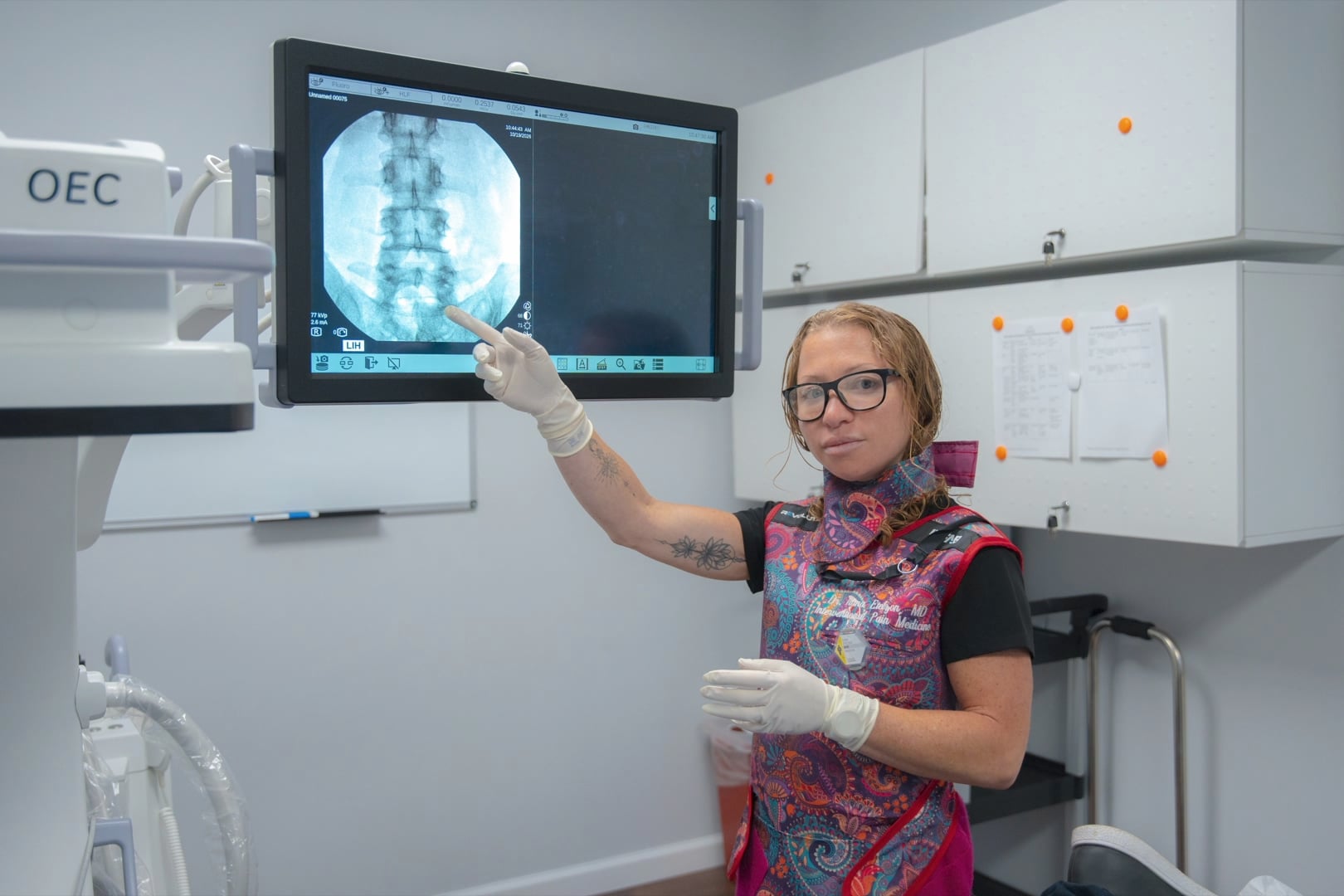
- Image-guided testingWhen needed, a precise diagnostic injection under X-ray guidance confirms which nerve level is involved.
- Your imaging, read closelyShe reviews your MRI and matches it to your exam, since many disc findings on MRI cause no symptoms at all.
You leave knowing what is irritating your nerve and what each part of your plan is for.
Reveal
Find every driver
Diagnose all the sources of pain before treating any of them.
Repair
Treat the tissue
Image-guided regenerative care aimed at the damaged structures.
Restore
Rebuild control
Strength and movement work so the area holds up under load.
Renew
Get back to life
Return to your activities and stay there.
Step two: Repair
Treatment matched to what is actually wrong
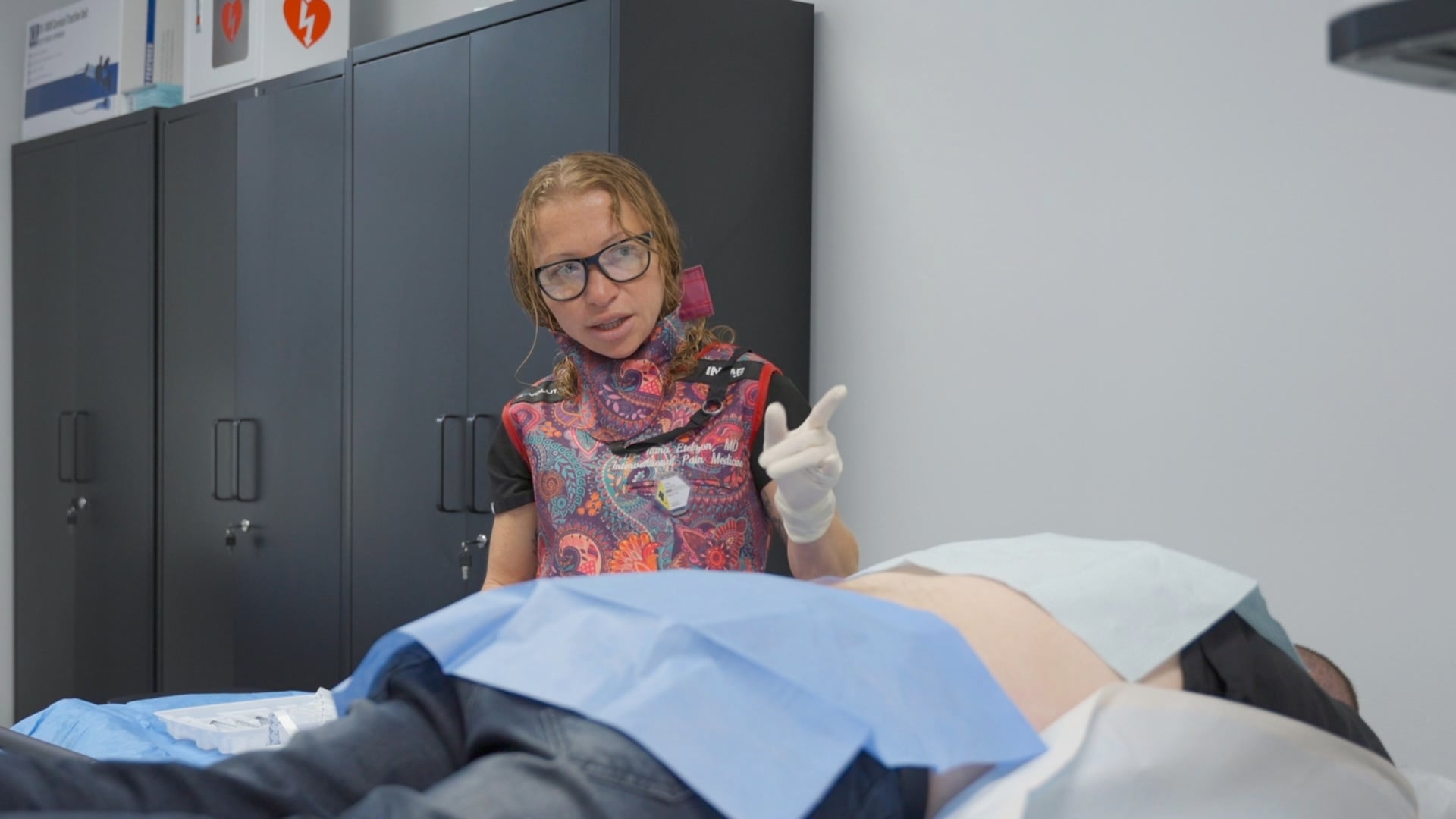
Once the source is clear, Dr. Etelzon chooses treatments that aim at it directly. Spine injections are placed under X-ray guidance, so they reach the exact nerve level and tissue that need them.
The SuperShot
An advanced regenerative injection built on extracellular vesicle science, used for damaged discs and the tissue around them.
Learn about the SuperShot ›PRP Injections
Platelet-based injections placed near the irritated nerve root and into loose spinal ligaments to calm inflammation and support healing.
Learn about PRP injections ›Bone Marrow Concentrate
Cells drawn from your own bone marrow, used for more advanced damage in the joints and supporting tissues of the spine.
Learn about stem cell injections ›Shockwave Therapy
Acoustic waves that relax a tight piriformis and the deep buttock muscles that can pinch the nerve.
Learn about shockwave therapy ›MLS Laser Therapy
A focused laser that reduces nerve inflammation and pain. It is often paired with injections.
Learn about MLS laser therapy ›Interventional Pain Care
When nerve pain needs fast relief, an epidural can calm it while the source is being treated.
See interventional pain care ›Where epidurals and surgery fit
An epidural steroid injection can calm a severe flare of nerve pain, and it has a place. Its relief is often temporary, so Dr. Etelzon pairs it with treatment aimed at the source. If you develop worsening leg weakness or trouble controlling your bladder or bowels, treat it as an emergency, because surgery may be needed right away.
Every pattern
What can help, by cause of sciatica
Sciatica has a few common causes. The cause guides the plan, and your specific drivers decide it.
Disc
Disc-related sciatica
Often sharp leg pain that worsens with sitting. Many herniations shrink over time, and targeted injections can calm the nerve while they do.
Narrowing
Stenosis-related sciatica
Leg pain with standing and walking that eases with sitting. Treatment aims at the inflamed joints and ligaments crowding the nerve.
Muscle
Buttock-related sciatica
Deep buttock pain with sitting. Shockwave, targeted injections, and stretching can release the muscle that is irritating the nerve.
An honest note. Most sciatica improves without surgery. When a pinched nerve is causing real weakness, Dr. Etelzon will tell you if a surgeon should take a look.
Results
Outcomes tracked across the Regenexx network
Regenexx collects patient-reported outcomes from certified clinics across the country. Explore the live results below.
Like all medical procedures, regenerative procedures have a success and failure rate. Individual results vary.
Step four: Renew


Back to sitting, walking, and sleeping comfortably
Patients come to us wanting specific things back: a round of golf, a long car ride, an evening on the deck, a full night of sleep. That is what we treat toward.
Back on the course
Easy afternoons again
Your first visit
What to expect, and what it costs
Your first visit is a consultation with Dr. Etelzon: your history, a hands-on exam, image-guided testing when needed, and a review of your imaging. Bring any spine MRIs or X-rays you have. If treatment makes sense, you leave with a written plan and a clear price before anything is scheduled.
Most regenerative procedures, including PRP and bone marrow concentrate, are not covered by insurance. Many patients use HSA or FSA funds, and monthly financing is available. See our payment and financing options.
Find us
Sciatica treatment across New York and New Jersey
Dr. Etelzon and her team treat sciatica at four offices, so care is close to where you live and work.
New York
Brooklyn
2577 East 17th Street, 1st Floor Unit 18B, Brooklyn, NY 11235Brooklyn office › New JerseyClifton
1111 Paulison Ave, Unit 2, Clifton, NJ 07011Clifton office › New JerseyNewark
73-75 Ferry St, Newark, NJ 07105Newark office › New JerseyPerth Amboy
345 State St, Unit B, Perth Amboy, NJ 08861Perth Amboy office ›Call 1 (844) 959-7246 to reach any office.
Keep reading
More on sciatica and spine care
References
- Chiu CC, et al. The probability of spontaneous regression of lumbar herniated disc: a systematic review. Clinical Rehabilitation. 2015;29(2):184-195.
- Brinjikji W, et al. Systematic literature review of imaging features of spinal degeneration in asymptomatic populations. American Journal of Neuroradiology. 2015;36(4):811-816.
Find out what is irritating your sciatic nerve
One visit, a clear answer, and a plan built around your back and leg and the life you want back. This is where the trying stops.