

Minimally Invasive Tendon Treatment
Tenotomy for Tendon Pain That Will Not Heal
When a tendon injury has held on for months through rest, bracing, and therapy, open surgery is no longer your only path forward. Tenotomy is a minimally invasive, ultrasound-guided procedure that clears out the damaged tendon tissue keeping you in pain, so the healthy tissue around it can take over. Most patients are in and out in under an hour and go home the same day.
Double Board-Certified
Ultrasound-Guided
In-Office, Same Day
Overview
What tenotomy does
Tendons are the tough bands that connect muscle to bone, and they are built to carry load every day. When a tendon is overused or injured, small areas inside it break down and stop healing on their own. That breakdown, called tendinosis, is what keeps the pain going long after the original strain. Anti-inflammatories and cortisone can quiet the symptoms for a while, though they do nothing to the damaged tissue underneath, which is why the pain keeps coming back.
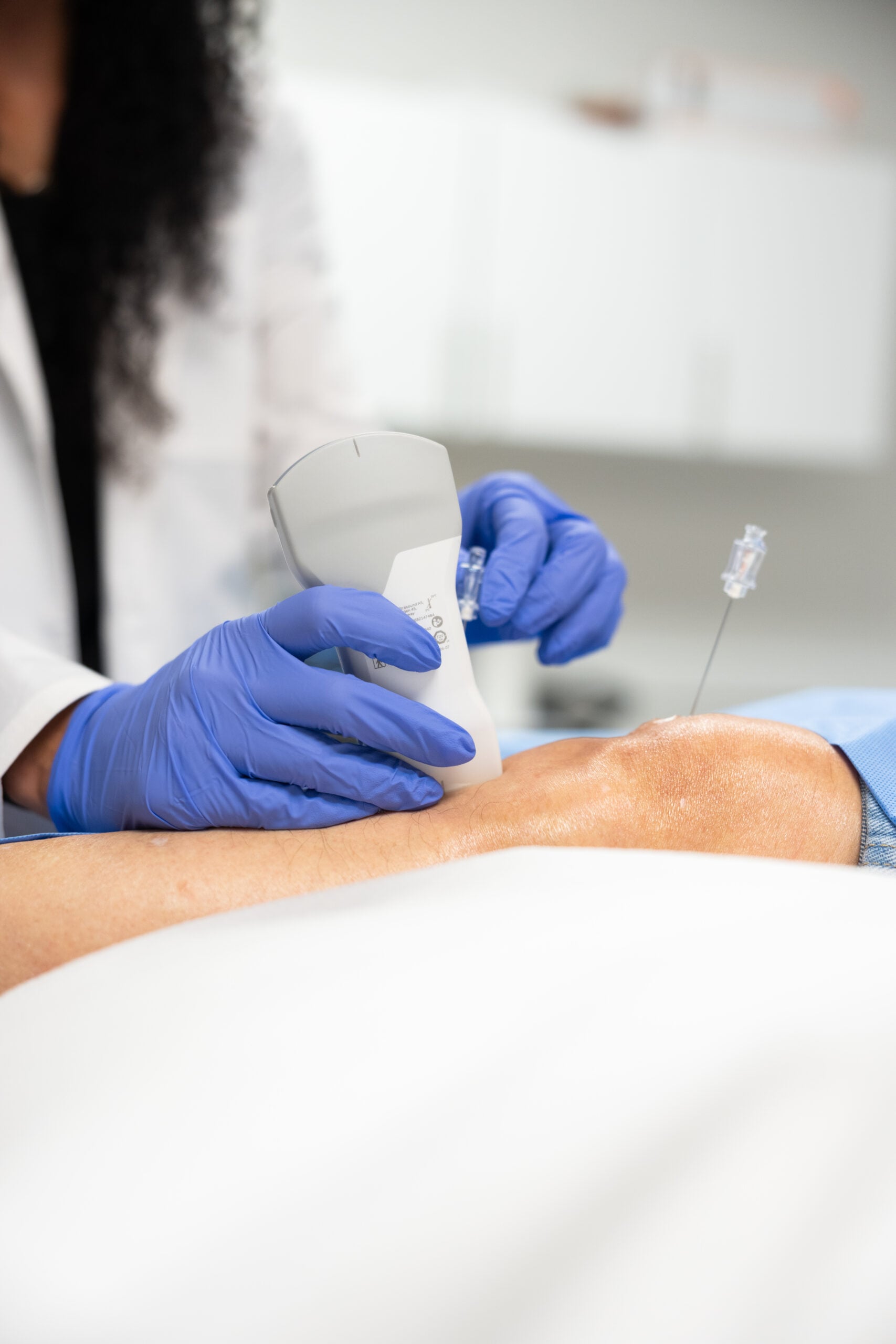
Tenotomy goes straight to that tissue. Also called percutaneous tenotomy or ultrasonic tenotomy, the procedure uses live ultrasound so Dr. Ilana Etelzon can see inside the tendon and guide a small instrument through a needle-sized opening in the skin. She breaks down and removes the degenerated tissue so the body can clear it and rebuild healthy tendon in its place. There is no open incision and no general anesthesia, and the opening is small enough to close with a bandage.

How it is done
Two devices, one goal
Dr. Etelzon performs tenotomy with two advanced systems and chooses the one that fits your tendon and the extent of the damage. Both reach the same result through a tiny opening, with no stitches and no hospital stay.
Water-Jet Tenotomy
TenJet
TenJet uses a fast, precise stream of saline to cut away and flush out the damaged tendon tissue in a single step. The fluid lifts the debris out through the same opening it entered, which keeps the healthy tendon around it undisturbed. It is a strong fit for thicker, more degenerated tendons where clearing volume matters.
Learn about the TenJet procedure ›
Mechanical Tenotomy
TendoNova
TendoNova reaches the same goal through purely mechanical action, with no water stream involved. The device breaks down and removes the degenerated tissue directly, which makes for a clean, controlled procedure in tighter or more delicate areas. It is the system Dr. Etelzon has been using most recently.
Learn about the TendoNova procedure ›
Conditions
Tendon problems tenotomy can treat
Tenotomy works best on long-standing tendon pain that has not responded to rest, therapy, or injections. If you have been living with any of these, it may be worth a look.
Plantar Fasciitis
Stubborn heel and arch pain from breakdown in the plantar fascia.
Tennis & Golfer's Elbow
Lateral and medial epicondylitis that has not settled with therapy or steroids.
Achilles Tendinosis
Chronic pain and thickening in the Achilles tendon above the heel.
Rotator Cuff & Shoulder
Shoulder tendon degeneration and ongoing rotator cuff pain.
Hip Tendinopathy
Gluteal and outer-hip tendon pain, including stubborn trochanteric cases.
Patellar Tendon
Jumper's knee and other long-running patellar tendon pain.
Not every tendon is a candidate for tenotomy. Dr. Etelzon reviews your imaging and examines the area before recommending the procedure.

Your Visit
What the procedure is like
Tenotomy is done in the office, and the whole visit usually takes about an hour. The procedure itself is often finished in fifteen to twenty minutes. You stay awake the entire time, with a local anesthetic numbing the area so you feel pressure at most.
- NumbingA local anesthetic is placed so the tendon and skin are comfortable.
- ImagingLive ultrasound pinpoints the exact damaged tissue.
- TreatmentThe device clears the degenerated tissue through a tiny opening.
- Home the same dayA bandage closes the site and most patients drive themselves home.
Most patients ease back into light activity within a few days, and the tendon continues to rebuild over the following weeks. Because the source of the pain is gone, the relief tends to hold instead of fading like a temporary shot.
Who performs it
Precision is what makes it work
Dr. Ilana Etelzon is double board-certified in pain medicine and physical medicine and rehabilitation, and she performs every tenotomy under live imaging. Seeing the tendon in real time is what lets her reach the damaged tissue and leave the healthy tendon around it alone.
"The reason this works is precision. When I can see the damaged tissue on ultrasound and reach exactly it, I clear the problem and leave the healthy tendon untouched. That is what gets people back to the activities they love."
Dr. Ilana Etelzon, MD, Double Board-Certified Pain Physician
Find Us
Tenotomy across New York and New Jersey
Dr. Etelzon offers tenotomy at four offices, so you can get treated close to where you live and work.
Brooklyn, NY
Clifton, NJ
Newark, NJ
Perth Amboy, NJ
See if tenotomy can help your tendon pain
Bring us the tendon that has been holding you back. Dr. Etelzon will review it, look at your imaging, and show you the path forward. The first visit is a conversation, not a commitment.
Book a Consultation