

What Causes Knee Pain?
Most knee pain comes down to one of three things: a torn meniscus, an injured ACL, or osteoarthritis. Figuring out which one you’re dealing with is the fastest route back to stairs, long walks, and getting down on the floor with the grandkids without a second thought. Here is how to tell the causes apart, which signs mean it’s time to get checked, and what you can do about it without surgery.
The Three Most Common Causes of Knee Pain
Alexandra DeFrance, PA-C, a board-certified physician assistant specializing in orthopedics and regenerative medicine at Pain Doctors Medical, sees the same three culprits again and again.
“The big three for me are meniscus tears, ACL tears, and osteoarthritis. The meniscus is the one that surprises people. You don’t need to be sliding into second base. You squat down to grab a bag of potting soil, twist a little on the way up, and something catches. The ACL usually comes with a story. There’s a pivot, sometimes a pop you can hear, and suddenly your knee feels like it belongs to somebody else.”
Meniscus Tear
The meniscus is a C-shaped cushion of cartilage between your thigh bone and shin bone. Tears can happen in a single awkward twist or build slowly as the tissue ages. Common signs include pain along the inside or outside of the knee, swelling, and a catching or locking feeling.
ACL Tear
The anterior cruciate ligament keeps your shin bone from sliding forward and rotating too far. It tends to tear during quick pivots, sudden stops, or a bad landing. Swelling comes on fast, and the knee may feel loose or give way.
Osteoarthritis
Osteoarthritis is the gradual breakdown of the cartilage that lets the joint glide. It is the most common cause of long-term knee pain in adults over 40, and it usually causes morning stiffness or pain after sitting, plus pain that worsens with activity. It moves through four stages of osteoarthritis, from mild cartilage wear to bone-on-bone.
Knee Pain Without an Injury
If you can’t point to a moment when it started, the answer is often arthritis.
“If you can’t remember hurting it, my money’s on arthritis. It creeps in. First, it’s the stairs. Then it’s getting out of a low car. Then one day you realize you’ve been picking restaurants based on how close you can park.”
Overuse can also play a role. Tendons around the kneecap, the bursa sacs that cushion the joint, and the band of tissue along the outer thigh can all get irritated by repetitive activity, extra body weight, or changes in how you walk.
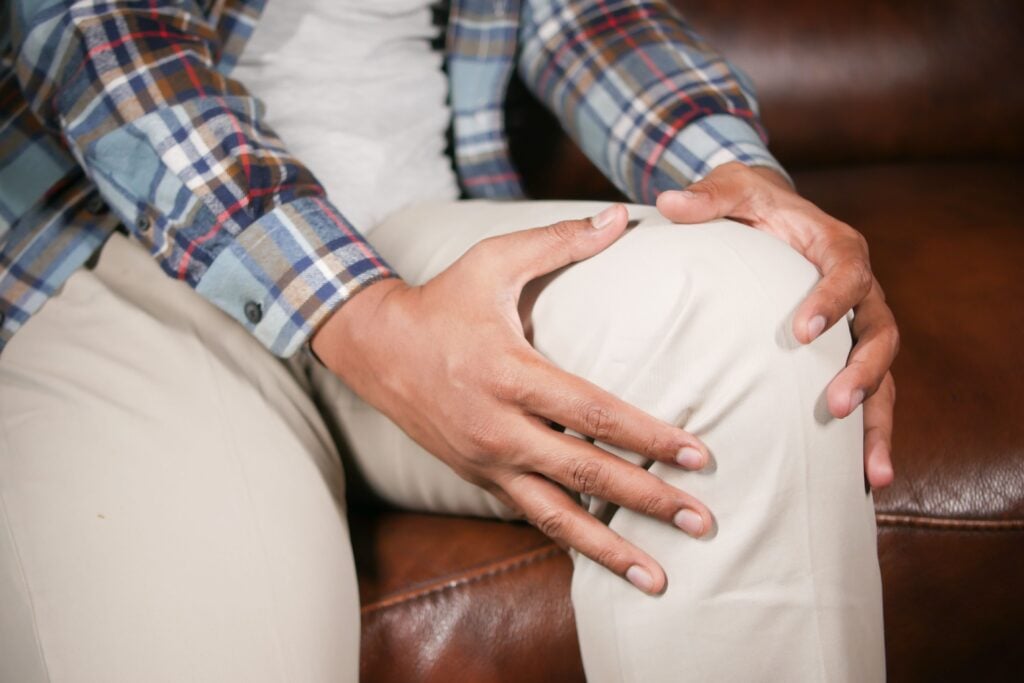
How to Tell If Your Knee Pain Is Serious
Pain that fades after a day of rest is usually your knee asking for a break. Pain that shapes your plans deserves a closer look.
“My rule is simple. If your knee is making decisions for you, come in. You’re skipping the walk, saying no to the trip, planning your whole day around it. And sharp, shooting pain gets my attention faster than a dull ache. A dull ache usually means irritation. Sharp can mean something is torn or pinched, and that’s worth a look.”
Other signs to take seriously include a knee that locks, gives way, or swells quickly, and any pain that wakes you at night.
Treatment Options for Knee Pain Besides Surgery
Surgery is one option on a long list, and for many people, it sits near the bottom.
“People come in thinking it’s surgery or nothing. It’s a long list. There’s regenerative medicine, so PRP and stem cells. There are cortisone and gel injections, which can buy you some time. And there’s shockwave and laser, which most people have never heard of and then can’t stop telling their friends about.”
At Pain Doctors Medical, care follows a four-part approach: Reveal, Repair, Restore, Renew. It starts by finding the true source of the pain, then builds a plan around four core regenerative medicine therapies:
- PRP injections place concentrated growth factors from your own blood into the damaged joint, tendon, or ligament under ultrasound guidance.
- Bone marrow concentrate injections use your own cells, processed under the Regenexx protocol, for more advanced joint damage.
- MLS laser therapy calms inflammation and improves circulation around the knee.
- Shockwave therapy, also called ESWT, sends acoustic pressure waves into sore tissue to increase blood flow and support repair.
Back to Walking Without Thinking About It
Some patients want results without a single needle. DeFrance had one who said exactly that.
“She had pain on the inside of her knee, and she was very clear with me: no injections, no surgery. Fair enough. So we did shockwave, which feels like a deep, dull thump right on the sore spot, and laser, which you barely feel at all. It’s almost boring. A few weeks in, she was walking without thinking about her knee. That’s the whole goal. You stop noticing it.”
Every knee is different, and results vary. An evaluation is the only way to know which approach fits you.
Get Your Knee Evaluated
Knowing what causes your knee pain is the first step toward fixing it. Pain Doctors Medical treats knee pain at offices in Brooklyn, Newark, Perth Amboy, and Clifton, led by Dr. Ilana Etelzon, MD, a double board-certified physician in Physical Medicine and Rehabilitation and Interventional Pain Management. Take the Pain Quiz or schedule a consultation to find out what’s behind your knee pain and how to get back to the things you love.